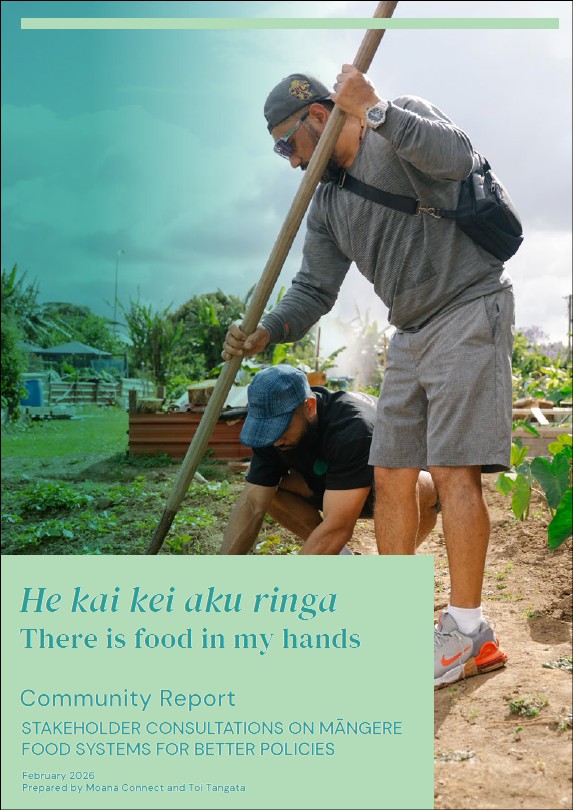
There is food is in my hands. Community report – February 2026
Author:
Moana Connect, Toi TangataSource:
Moana Connect and Toi TangataPublication date:
2026Topics:
People ,EnvironmentHe kai kei aku ringa – There is food in my hands. Community report – February 2026
Stakeholder consultations on Māngere food systems for better policies
Executive summary
This whakataukī translates literally as ‘there is food in my hands’, which speaks to food access, but also inspires a broader understanding of sovereignty, capability and collective success. When the initial call was made to explore food systems, food security and food sovereignty in South Auckland with a focus on Māngere, it was vital that the search acknowledged the importance of local and collective leadership and ownership of this work.
This report presents the findings of the Māngere Food Systems Policy Project, a community-led initiative aimed at transforming food systems in South Auckland through policy advocacy, systems thinking, and indigenous knowledge. Initiated by a collaborative facilitated by Health Coalition Aotearoa – Moana Connect, Toi Tangata, Healthy Families South Auckland, and the University of Auckland – the project’s design was aimed at centring the voices of local stakeholders, community groups and grassroots organisations who work closely with whānau.
Purpose and Approach
The project sought to understand the systemic barriers to food access, affordability, and sovereignty in Māngere, and to identify policy levers that support community-led solutions. Using kaupapa Māori and Pacific methodologies, the team conducted talanoa interviews, cognitive and systems mapping, and a community validation workshop. The approach was relational, inclusive, and grounded in cultural values.
Key Findings
Food Insecurity and Affordability:
Many whānau face significant barriers to accessing nutritious, culturally appropriate kai due to low incomes, high living costs, and the dominance of convenience, fastfood outlets. School lunch programmes like Ka Ora, Ka Ako have made a positive impact, reducing stigma and improving student wellbeing. Food banks have also ensured access for whānau; however, structural and systemic challenges make it hard for some families to access nutritious food.
Revival of Indigenous Knowledge and Practices:
Community groups are actively reviving mātauranga Māori and Pacific food practices through māra kai, wānanga, and intergenerational learning. Initiatives such as Te Pu-ā-Ngā Māra, Whenua Warrior and MANAVA demonstrate the transformative power of reconnecting with whenua and kai.
Local Initiatives and Innovation:
Organisations such as I AM Māngere, Tatou Social Supermarket, and Papatūānuku Kōkiri Marae are leading innovative responses to food insecurity, combining cultural knowledge with practical support. This is not an exhaustive list as Māngere is home to multiple examples of effective and potential approaches that can elevate strengths, create employment and contribute to a sustainable food system in Māngere. However, they face challenges including funding instability, regulatory barriers, and limited land access.
Systems Mapping and Policy Levers:
Many parts of the system are connected and inter-related. A systems map was developed to identify feedback loops and leverage points across six themes: local food systems, community capacity, household economics, industrial food systems, school food, and food consumption. While these themes are applicable anywhere in the world, what these look like in action, and the dynamics and relationships within local settings can be unique to that community, as described in this report. These insights informed an initial community consultation on potential actions and a set of proposed policy interventions.
Policy Recommendations
- Policy levers have been identified in all aspects of the Māngere food system. In summary, the following areas are crucial:
- Enable urban farming and community gardens through Auckland Unitary Plan reforms.
- Support social enterprises and cooperative food models with tailored legal structures.
- Strengthen the Ka Ora, Ka Ako programme with local procurement and sustained funding.
- Regulate fast-food outlet density and advertising near schools.
- Address poverty and food affordability through national policy levers such as tax reform and living wage initiatives.
Next Steps
The South Auckland Food Policy Project (SAFPP) is entering a pivotal phase focused on validating findings with Māngere whānau and hapori, strengthening relationships, and mobilising collective action for policy change. Late 2025 will prioritise sharing and validation through hui and community engagement, while laying the groundwork for a community-led collective to guide decisions. From late 2025 to early 2026, this group will identify key policy priorities based on impact and local values and codesigning advocacy strategies for improving local food access and sovereignty. By early to mid-2026, agreed priorities will be activated with backbone support from the SAFPP Steering Group, aiming to create a movement rooted in whakapapa, mana motuhake, and the right to nourish our people.
Conclusion
The Māngere community holds deep knowledge and leadership in food systems transformation. This report celebrates existing mahi, identifies systemic barriers, and proposes actionable pathways toward food sovereignty. It calls for sustained investment, policy reform, and recognition of Indigenous and Pacific approaches to kai, whenua, and wellbeing.
February 2026
See also
Moana Connect, www.moanaconnect.co.nz
Toi Tangata, www.toitangata.co.nz
He kai kei aku ringa – The food is in my hands. Foundation report – January 2026